


What is an action figure?
Nov 13, 2023
Leave a message
What is an action figure?
Action figures are often based on characters from movies, comic books, military, video games or television shows; fictional or historical. These figures are typically marketed to boys and adult collectors. The term was coined by Hasbro in 1964 to market GI Joe to boys (while competitors called similar products boy dolls).
According to a Swedish study, action figures displaying traditionally masculine characteristics are primarily aimed at boys. Although most commonly marketed as children's toys, action figures have become widely accepted as adult collectibles. In this case, the item may have been produced and designed with the assumption that the item will be purchased solely for display as a collector's item and not for play like a children's toy.

The history of action figures
1960s to 1970s
The term "action figure" was first coined by Hasbro in 1964 to market their GI Joe figures to boys who refused to play with "dolls," and the term is primarily associated with toys for girls. (Rosko Industries introduced a similar toy called Johnny Hero for Sears in 1965, but it was called a "boy doll" because the term "action figure" wasn't widely used at the time.) GI Joe was originally a The military-themed 11.5-inch figure was developed by marketing and toy creative man Stan Weston. It features changeable clothes and a variety of uniforms to suit different purposes.

In order to make such toys popular around the world, Hasbro also licenses the product to companies in other markets. These various licensees have uniforms and accessories that are generally the same as those made by Hasbro for the U.S. market, as well as some sets that are unique to the local market. There are at least two examples in Japan where Hasbro licensees also issued sublicenses for related products. For example, Palitoy (UK) issued a sublicense to Japan's Tsukuda Corporation to manufacture and sell Palitoy's ActionMan accessories in the Japanese market. Takara also issued a sublicense to Medicom to manufacture action figures.

Takara still has a license from Hasbro to manufacture and sell GI Joe toys in Japan, and has also built an action figure using a licensed GI Joe torso from Henshin Cyborg-1, using clear plastic to reveal the cyborg guts, as well as a chrome head and cyborg feet. During the oil supply crisis of the 1970s, Takara, like many other action figure manufacturers, struggled with the costs associated with manufacturing large 111⁄2-inch figures, and as a result, smaller versions of the robot toys were developed, Standing 33⁄4 inches tall, it was first sold in 1974 as the Microman. The Microman series was also novel in its use of interchangeable parts. This set the stage for smaller action figure sizes and transforming robot toys. Takara began producing characters in the Microman series with increasingly robotic features, including Robotman, a 12-inch robot with room for a Microman pilot, and Mini-Robotman, a 33⁄4-inch version of Robotman. The toys also feature interchangeable parts, with an emphasis on character transformation and combination.

In 1971, Mego began licensing and producing American Marvel and DC comic book superhero characters. The sales of these characters were very successful and are now considered highly collectible by many adults. They eventually brought the Microman toy line to the United States as Micronauts, but Mego ultimately lost control of the market when it lost the license to produce Star Wars toys to Kenner in 1976. The widespread success of Kenner's Star Wars Episode III 3⁄4" toy line made newer, smaller-sized figures with molded costumes the industry standard. Rather than individual characters' costumes changing for different applications, the toy line Featuring teams of characters with special features. Driven by Star Wars-themed sales, collectible action figures quickly became a multi-million dollar secondary business for the movie studios.

From 1972 to 1986, Mattel produced the famous line of Big Jim action figures.
1980s to 1990s
The 1980s gave rise to a variety of popular action figure lines, many based on the cartoon series, and they served as one of the marketing tools for toy companies. Some of the most successful titles are Masters of the Universe, GI Joe, Thundercats, The Real Ghostbusters, and SuperPowers Collection, to name a few. At the beginning of this century, the rapid popularity of Japanese robot anime such as Gundam also prompted Takara to reinvent the Microman series into MicroRobots, moving from the concept of robot action figures to the concept of living robots. This led to the MicroChange line of toys: objects that can "transform" into robots. In 1984, Hasbro licensed MicroChange and another Takara line, the Diaclone transformer, and combined them into Transformers in the United States, spawning an animated series that is still ongoing.
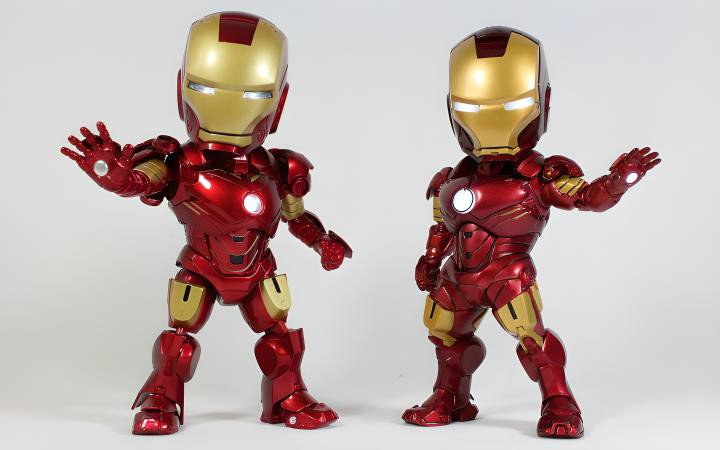
As the 1980s came to an end, more and more collectors began to emerge, purchasing toys to preserve their original packaging for display and future collection. This has led to the proliferation of the action figure toy market. One of the most popular action figure lines of the late '80s and early '90s, Teenage Mutant Ninja Turtles action figures were produced in such high numbers that most figures were never worth more than a few dollars. In the mid-1990s, a new line of Star Wars action figures surfaced, and Spawn figures flooded toy store shelves, proving that action figures were no longer just for kids. Since 1997, ToyFare magazine has become a popular read among mature collectors, providing news and nostalgia with a comedic twist. With the increasing popularity of the Internet, sites like Toy News International will soon provide information about upcoming collectibles and merchandise.

It was during this time that popular characters increasingly received specialized costumes and variations. Batman quickly gained notoriety as a result (i.e. Arctic Batman, Piranha Blade Batman, Neon Armor Batman). Rather than individual characters, these variants form the bulk of many action figure lines, often using old figure and accessory molds. In the early 1990s, glow-in-the-dark characters and accessories also became popular, such as ToxicCrusaders and SwampThing.

Action Figure Accuracy
A common feature of action figures are body joints, often called points of articulation (POA) or joints. The most basic form of joints includes a neck joint, two shoulder joints, and two hip joints. In addition to this, rotating the wrist, bending the knees, and rotating the waist are also common. Various terms have entered practice, such as "cutting" joints, often used to allow basic head rotation at the neck or arm rotation at the shoulders. The "T" joints at the character's hips usually allow the front and rear legs to rotate up to 180°; however, this may vary. Ball joints often allow for freer movement than cutouts, such as the ability for the figure's head to tilt in addition to the cut's strict vertical rotation. Basic knee joints typically rely on what are called pin joints.

Over the years, toy designers have varied in the number and style of graphic expressions they have used. Two of the most popular character lines of the 1980s, G.I. Joe: Real American Hero and Masters of the Universe, contrasted sharply in expression; the former packed a few spots into its small 33⁄4-inch scale, while the latter was kept minimal. However, both used the hip rubber cord method which is rarely used today. In the 2000s, ToyBiz's popular Marvel Legends line was known for its high articulation, even with points on the abdomen, toes, and fingers.
